If you are a graduate student looking for your first internship or full-time job, you will most likely be faced with challenges to choose your career path among tons of options. Opportunity cost holds people in hesitation and sometimes makes you miss opportunities to try things. We have been there and understand the situation. Therefore, we would like to offer you with the bite-size experience sharing series to help you start.
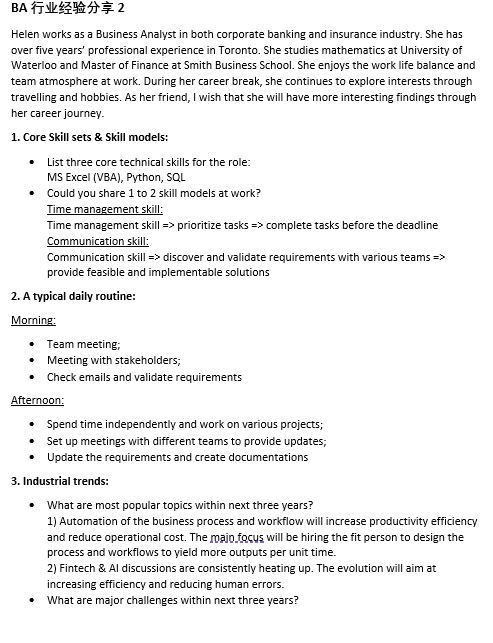
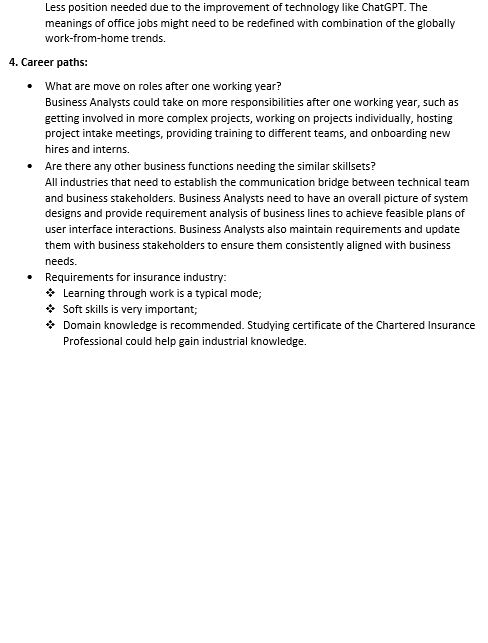
In a more practical saying, Business Analysts serve as a function to communicate with both the business and the development teams, in order to drive better project outcomes. Even though Business Analysts are not directly taking part in business or development activities, Business Analysts should be the best to consult to understand the situation. Requirements analysis and gap analysis are major deliverables provided by Business Analysts within the business scope. In collaboration with developers, Business Analysts should be able to build a feasibility plan to make things happen.
The writer referenced the QS Business Master’s Rankings for Business Analytics 2023, as well as MBA programs specialized in Business Analytics, to get a full list of Business Analytics education programs in the States. The following factors are considered for each business programs:
AACSB certified: Global Business Education Network; connects educators, students and business, and provides career-oriented services
STEM certified: recognized science, technology, engineering, and mathematics programs; can be used to apply for 24-month OPT (Optional Practice Training) extension
Capstone Project: practical industrial project that could help gain project experience
Internship: some of the Business Analytics program offers a short term during the semester internship, which is usually about six to eight weeks
Curriculum: syllabus and study goals
International Students Rate: it is used to measure the program’s culture diversification and your student experience, but you could always add to your portfolio to experience more by studying abroad
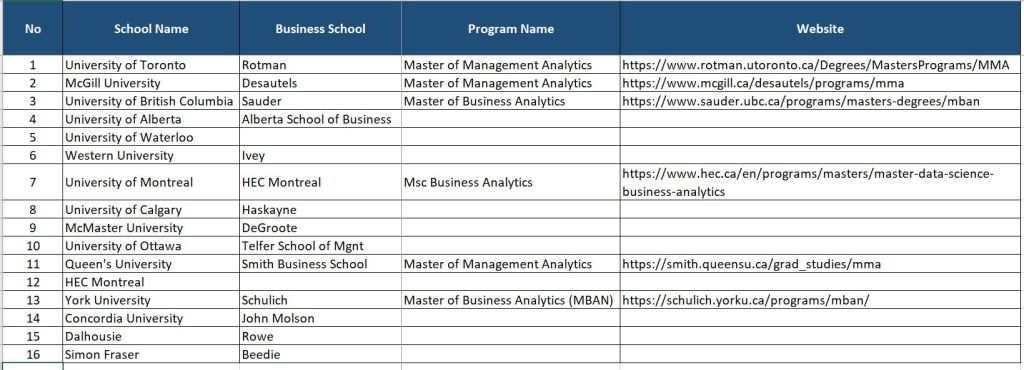
**Please note that the checklist is only used for academic purpose. If you need the full list of universities and programs, you could contact us for further information
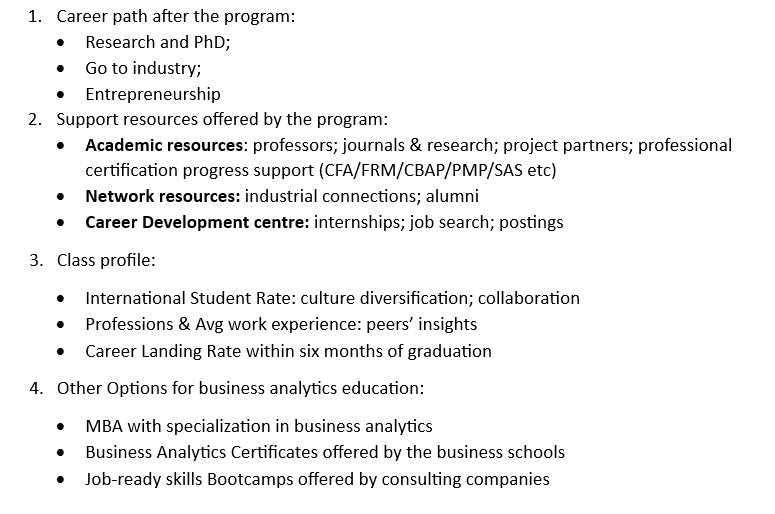
To achieve better study outcomes, you need to be clear about your study goals. A business analytics program could help students in the following aspects:
1) Acquire business analytics methods;
2) Gain insights in one applicable fields;
3) Receive career development services
Top Asked Questions:
1. Should I take an engineering degree to learn programming?
To be a Business Analyst, database (SQL) and statistical (R/Python) languages are adequate for daily work competency. An engineering degree will enable you to be a developer, software engineer, or equivalent. According to Glassdoor, the average salary of a Business Analyst is $70k and the average salary of a Software Developer is $90k in Toronto. (https://www.glassdoor.ca/) The expected learning outcomes and career goals is very important to choose between engineering and business programs.
2. Compare MBA and MS in Business Analytics:
Personally, I don’t think it is a good idea to compare MBA with Master of Science programs. However, if you might be wondering, there could be a reason. MBA is usually the most expensive investment in a business school, hence representing the highest quality of formal business education. Students go to business school not only to learn the business facts, but also to interpret the facts and make better business decisions. All these considerations make MBA still the optimal choice for business students.
MS in Business Analytics is more focused on leveraging the data technology to empower a business. Nowadays, digitalization is a major trend in all sectors of business. The practical data analytics skills learnt from MSBA could help students get adapted to most of the future career trends.
From the employment perspective, you could check the following indicators to evaluate if a MS in Business Analytics program is a good choice for you:
Skills Set built through the learning program
Project Experience and internship experience
Career Outcomes: 1) employment rate within six months’ graduation; 2) companies and roles of the alumni; 3) graduates’ career paths in the five years
3. What Can I do after graduating from Business Analytics program?
The typical roles after graduating from MSBA are Business Analyst, Data Analyst, Business Intelligent Analyst, Consultant and Product Manager etc. Some of these roles are more business driven and roles like BI Analyst requires higher technical backgrounds.
Decision Model to pick a business analytics program:
How could you move on to a career of Business Analytics? If you happen to read this blog and have it on your mind to become a Business Analyst in the future, I would like to recommend you — get formal education (aka schooling) for a matching degree at your career beginning. It took me much detour to figure out the overall picture, and I sincerely hope that it will not be necessary for you. Well in return, how about be the cheerleader when you could for those who want to follow their heart?
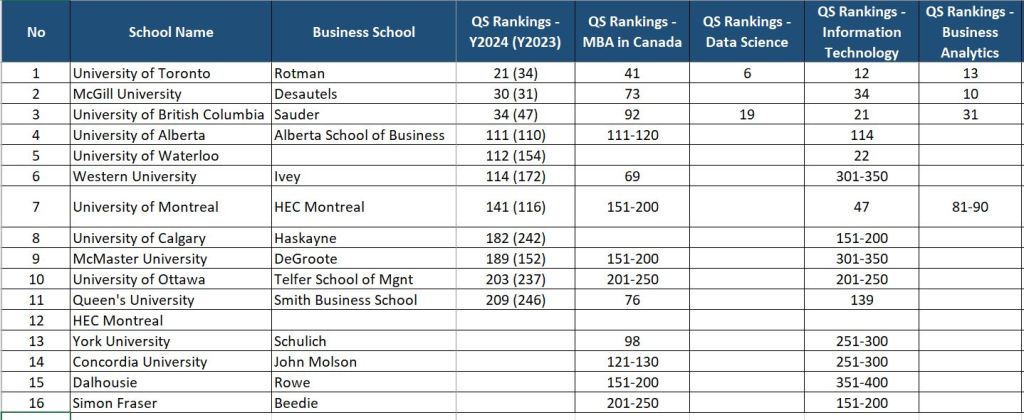
There is really no bad timing or good timing of a career. The sooner that you’ve collected the pieces of the puzzle, the better you could get started solving it. There are a lot of universities nowadays that provide degree options to get you educated in business analytics. The below chart is based on QS Rankings and relevant subjects of business analytics:
In Canada, universities are for the students who are in need of getting a formal degree and a structure-based course study. Some of the programs will offer co-op opportunities which are helpful for the students to get relevant work experience. Alternatively, you could also find local colleges that provide equivalent study and their courses are designed in more practical methods. Both universities and colleges could enable you start your Business Analytics career, especially in the local market.
If you are interested in learning more about educational programs in Business Analytics, you could get in touch with us from the contact page. You could also find more information about Canadian high school education through the link: xiaohongshu_shares
Please note that the above information is only created for educational references. They are not in commercial use and the writer provide her viewpoints solely based on her judgment of how to be a qualified BA. Wish you a treasure finder along the journey! Happy Study 🙂
In today’s world, business has been connected more coherently than before with data. A lot of graduates might be wondering, which career should we choose? Business Analyst or Data Analyst? What’s the difference between these two career paths?
By wording, Business Analyst is more focused on business requirements and Data Analyst is more focused on creating data insights. However, to differentiate these two roles probably will not bring in any business values, yet creating more confusion.
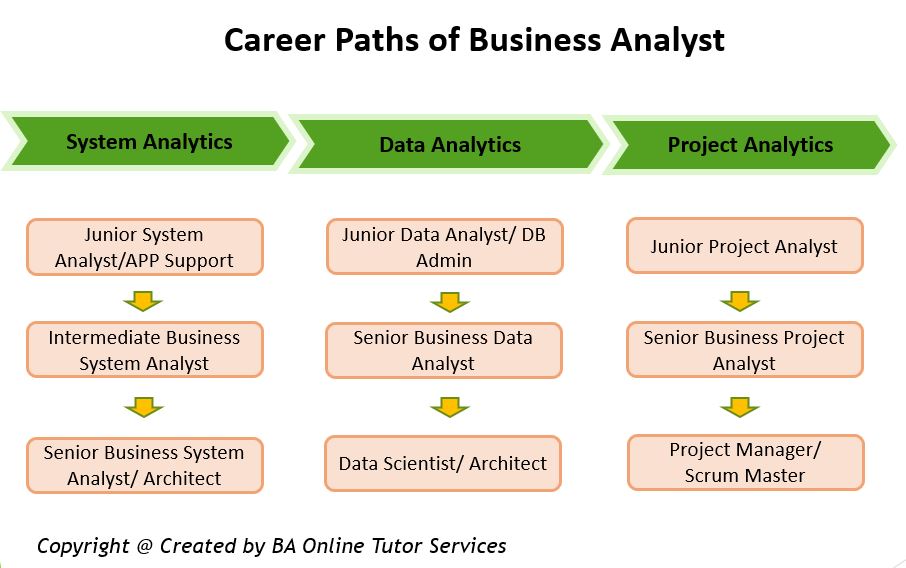
As a new graduate, you could get a better idea about these roles by taking a closer look at the career paths of different types of Business Analyst.
Alongside the trends of digitalization and data management, the market demands of Business Data Analyst will be continuously on the rise. Tech companies that provide software solutions need this position to re-engineer the database and find ways to increase data quality for the corporate users. Customer facing applications running data forecasting on business will need this role to provide more business insights and find solutions to protect data privacy. Traditional industries, such as manufacture, auto-vehicle, and consumer goods, recruit Data Scientists to build data pool to produce customer insights based on IoT systems. The writer has interviewed with professionals from e-commerce, entertainment, and supply chain industries. These sectors might not typically hire large amount of data analysts, but professionals have made good practice in combining data analytics and marketing. From the company’s perspective, boosting sales is always the core of business strategies.
So how to start a career as Business Data Analyst? The skillsets required are as simple:
Basic skills: SQL, Python, Excel; BI Tools (Tableau/ Power BI/ SAS etc)
Advanced skills: Machine Learning, Deep Learning, Artificial Intelligence, Modelling
Data analytics & business insights
Data storytelling & visualization
Nowadays, interacting with customers and applying machine learning/ deep learning at work are in high demand to generate revenues and increase efficiency and productivity. As new graduate, you could bring into business with refreshing mindsets and cutting-edge analytical techniques.
A fresh new graduate? You could possibly be caught eyes already by a career of Business Analyst as highly paid and future embracing. The industries that are hiring most of Business Analysts are financial services, banking, manufacturing, healthcare and technology companies. From its origin, Business Analyst is a function to implement business ideas by providing tech solutions, say collaborating with developers to build software to meet business needs such as accounting, risk management, supply chain and more.
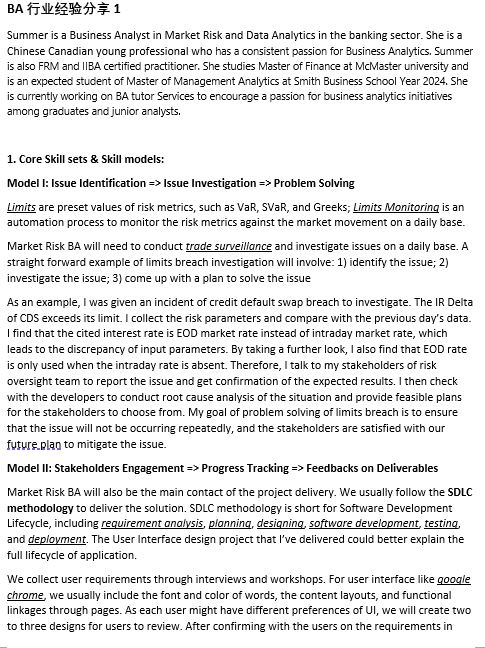
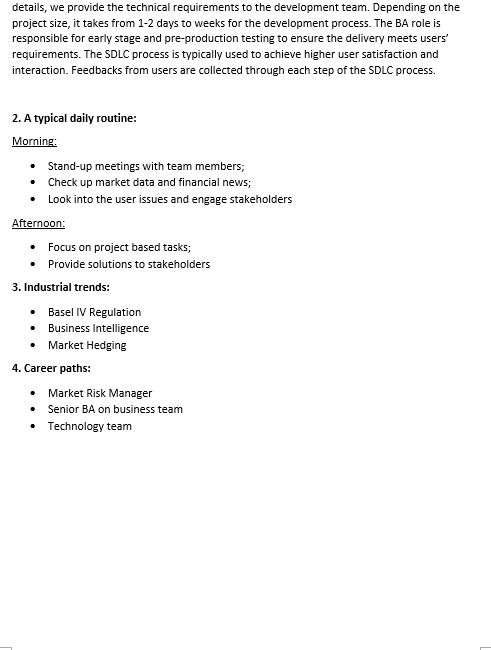
I found my first BA job in six months after my graduation from Master of Finance. From that time on, I start my career of Business Analyst by accumulating hands-on project experience in the real simulation. Back in 2016, BA is still a new option for most of the graduates. The first company that I’ve worked for, FDM Group, provides with education solutions as a package to gain basic business analytics skills such as SQL, Excel VBA, QA testing etc. They helped me land on my first job, while it takes long time for me to figure out what BAs really are. As an international student by that time, I need to talk as fluently and think as natively as other Business Analysts grown-up locally in Canada. It is not an easy thing for people like me, spending most time being educated in a different culture. Efforts that I’ve tried to manage that gap: writing a book summary of a real estate story and presenting it to the advisors in retail banking, working in a coffee shop and making friends with my coworkers to practice English, participating as much as I could for the university events to get connected with professionals. All these things help accumulates the basic points for me to find my working style being an BA.
A roadmap of my business analytics career:
What’s the competing edge for an Asian student?
As an Asian student, we are always labeled as hard-working, technical-driven, and introverted. In recent years, I am glad to see that more Asians have the willingness to step out of their comfort zone and express and present their business image to their colleagues and clients. Social media fuels the courage. But more importantly, an Asian face is given more opportunity to show our talents in a broader business world. I still think that being a traditional type of Asian is one of the most competing edge. In school, we all have struggled for higher GPAs, more society activities, and got involved in sports and artistic events. As a professional, an Asian heritage really doesn’t mean more than any other cultural background. As diligent, we should focus more on how to present ourselves and understand the business. Even though by highly chance, we might just end up earning breads and exchange talents for necessities, it is still very important to try and explore despite of how we’ve been taught and told.
Since I’ve been on a work trip to Asia last September, I have got the chance to reconnect with colleagues working in the field. If you happen to study aboard and come back Asia for job searching, I would say better you could add strategic thinking and business presentation to your skills portfolio. Retail business is rapidly growing since the reopen, and it could be an opportunity for students who would like to try BA roles but lack of software development or project experience.
How to be a qualified BA?
Critical thinking
Good communicator
Programming skills
Business acumen
Critical Thinking:
logic is important
rule out emotion and bias
objective; reasonable
Good Communicator:
what should you listen?
emotion: try emotion check to make sure you talk in a good time
assumption:
expectation: what the outcome to expect from the conversation?
acceptance: what the standards to set of the topic?
logical cause: what brings them from A to B?
How do you get prepared for a professional talk?
objective (if you are emotional try to label your feelings and be aware)
business image: what do you want other people to see you in your work?
e.g. assertive, determined, flexible, or compromised
expected results: what do you want to achieve by this conversation?
e.g. Let my co-workers like me; show co-workers with my personalities; impress my manager of the project results; ask for help or get more resources
recap: one or two things could remind your colleagues or clients of what you’ve discussed





 BA Online Tutor Services